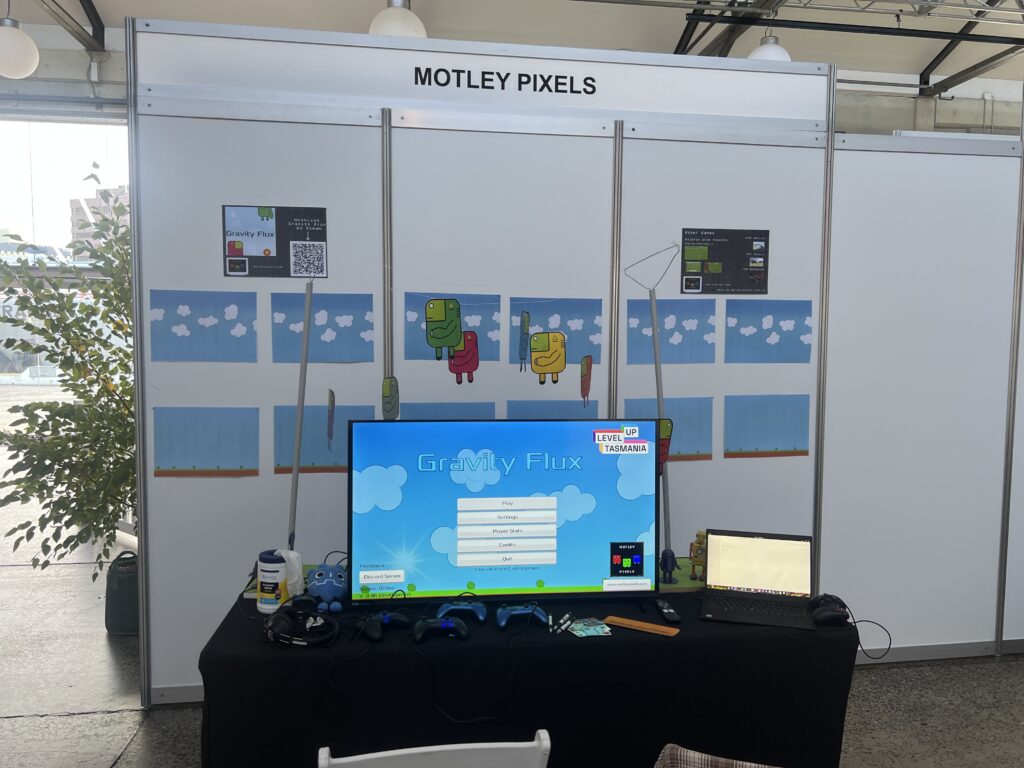
On April 17-19 2026 I participated as an exhibitor in the (Tasmanian) Level Up Tas games showcase. The public event where Tasmanian made games were on display. Screen Tasmania sent out proposal forms, I entered Gravity Flux again (with some updates). And I was again accepted! I wasn’t 100% anticipating to be accepted, mainly after presenting the same game almost 2 years ago (which was released 4 years ago..). But I was of course quite happy to showcase the game. It is of course a very showcase floor friendly game, with multiple controller support.
The whole experience as an exhibitor was very smooth. I set up on Thursday, and came in on Friday and Saturday and did my thing and had no issues. I asked so volunteer to step in to help me for some short periods, which was greatly appreciated as it helped me recharge for the rest of the event. If I ever do another showcase even, I think the condition is I don’t do it all by myself (unless it is for a shorter period).
The Friday being a working day, it was a little quiet but not too bad. Then the Saturday was pretty busy, and I noticed that my game rarely went quiet, and a few participants from the crowds came back a few times!
I received a fair amount of positive feedback. The game was in a state of being more stable and functional than ever, and had a few but not many major issues. Previously, it had a bug where you would get stuck in the ground, which I have mostly fixed. The game crashed once or twice, but as it was running on Linux I made a script that just automatically restarted the game.
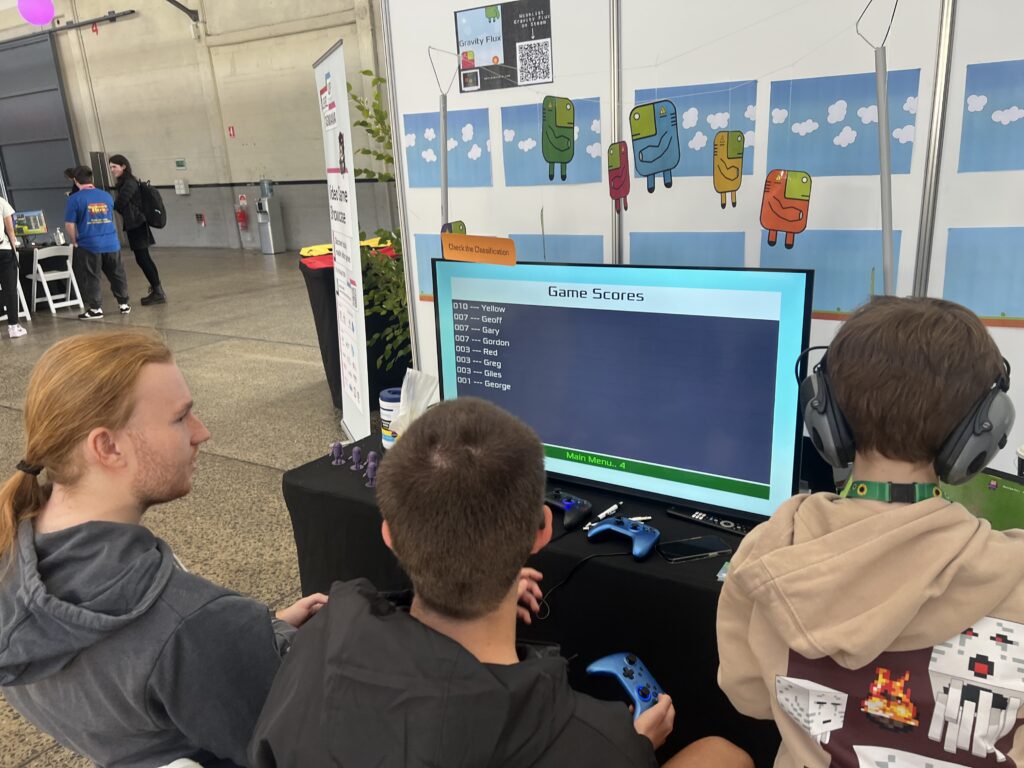
From the experience I saw from the players, I think the game appeals to a younger audience of course, but since the game mechanics are so simple, I think it has this endearing quality like older platformer games. You just want to keep playing even though the gameplay is not that complex. Akin to maybe sports or simpler traditional board games.
The direction I am hoping to steer the game in now, is to be more console friendly, with full controller support for Steam. Once that is achieved, it should be not too difficult to port to other consoles. I understand that being console friendly opens the doors to more sales. I think if I am going to release a game on a major platform, I may as well learn as much about releasing on a major platform, including implementing controller support. But also try to achieve things like localisation (different languages). Not so much for the intention of sales, but the experience (for future games).
The industry day was also great. We had the privilege of attending a talk from David Gaiter – the writer behind Baldurs Gate, Neverwinter Nights, Star Wars: Knights of the Old Republic, Dragon Age and Anthem. Part of his talk covered burnout, a subject relevant to me, which noted that he had a lack of support around burnout. I think this rings true for a lot of people who go through burnout unfortunately. I have learned a lot of valuable life lessons from recovering from burnout. There were other great speakers which inspired me a little, including how to apply for games grants, which essentially boiled down to, try to answer the grant questions as best you can. It’s not a free-form text box.
Overall Level Up Tas I am incredibly grateful that Screen Tas and Tas Game Makers hosted and ran the event. The games industry is a potential global export, an area that Tasmania could benefit from financially if we succeed. The Tasmanian economy I hear needs some support from somewhere. It could be a stadium, but that costs a lot more than funding the games industry. The games industry is only continuing to grow, any investment is only going to fuel the growth. I noted that the number of Tasmanian games on Steam is around 39 (source: https://tasgamemakers.com/tasmanian-games/). That number is only going to go up.
What’s next?
After my second-ever games showcase as an exhibitor, I am starting to think more deeply about how to steer my focus on making games. I have always had games in the pipeline, but after you see people who have been working on games for a long time, I have to wonder how do people make it work? Maintaining the drive and motivation to make games.
I think it comes down to a few key areas:
- Concept – a concept you are really passionate about
- Technical challenge – a technical challenge you won’t get burned out over (eg not cross-compiling on C/C++ with various fiddly build systems)
- Art style – using mostly your existing art skills so you don’t have to learn too much before you can see art in the game (or use it as a minor growth opportunity)
- Chances of reward – Something that will address an existing market
For me that’s a couple of options
- A new 3D game with low-poly assets – so I can extend on my beginner level 3D art skills
- Publish Lazy Bubble Platformer (a 2D retro platformer I made at a Global Game Jam) on mobile platforms using Godot
- Wizards with Rockets – a game kinda in development hell, but port it to Godot to speed up the assets and game mechanics development
In terms of what grant I may apply for next, I still have to think a lot more about that. I often find that my games are either too early in development, or in development hell. Gravity Flux only took about 1 year to release, I would say that the next grant will be for the next Gravity Flux, a game I plan to consciously release with or without grant funding. Which I haven’t got started on, just yet!